
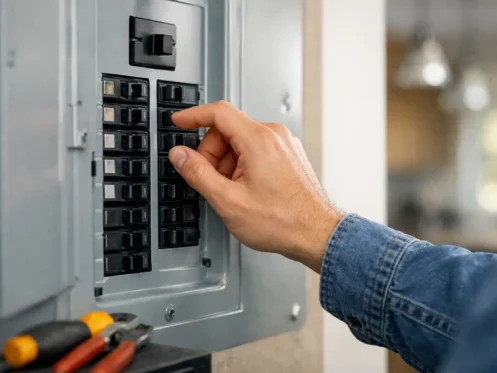
A breaker that trips once after you run the microwave, hair dryer, and toaster at the same time is usually doing its job. A breaker that trips repeatedly, feels warm, or will not stay on is telling you something more serious may be happening. Knowing how to reset tripped breakers safely can restore power after a simple overload, but it should never mean ignoring a warning sign in your electrical system.
Your electrical panel is designed to stop power when a circuit draws more current than it can safely handle or when it detects certain types of faults. That interruption protects wiring, outlets, appliances, and most importantly, the people in your home or business. The goal is not simply to get the lights back on. It is to identify whether the trip was a one-time event or a problem that needs professional diagnosis.
How to Reset Tripped Breakers Safely
Start by turning off or unplugging the devices that were running on the affected circuit. If the kitchen counter outlets went out, unplug the coffee maker, toaster, air fryer, and any other appliances in that area. If a bedroom circuit tripped, switch off lamps, space heaters, electronics, or anything else that may be connected.
Next, locate your electrical panel. In many homes, it is in a garage, utility room, basement, closet, or on an exterior wall. Open the panel door, but do not remove the metal cover inside the panel. The cover protects live components that should only be accessed by a qualified electrician.
Look for a breaker handle that is sitting in the middle position or has moved fully to the OFF side. A tripped breaker does not always look obviously off, so compare it with the neighboring breakers. Many panels have labels indicating which rooms or equipment each breaker serves, though older homes may have incomplete or inaccurate labeling.
To reset the breaker, push the handle firmly all the way to the OFF position first. Then move it firmly back to ON. You should feel it click into place. Return to the affected area and test a light or outlet.
If the breaker stays on and power returns, reconnect devices one at a time. This helps you determine whether a particular appliance caused the overload. Avoid immediately plugging every item back in, especially high-demand appliances such as portable heaters, hair dryers, countertop cooking equipment, or window air conditioners.
When You Should Stop and Call an Electrician
A breaker is not meant to be reset over and over. If it trips again right away, or trips as soon as you turn on a particular appliance or light, leave it off. Repeated resetting can allow an electrical fault to continue heating wiring or equipment behind the walls.
Do not reset a breaker if you notice a burning smell, buzzing, crackling, visible smoke, scorch marks near an outlet or panel, or a panel that feels hot. Those conditions call for prompt professional service. If there is active smoke, fire, or an immediate threat, move to safety and contact emergency services.
You should also call a licensed electrician when a breaker will not reset even after everything on the circuit has been unplugged. The cause could be a damaged outlet, failed appliance, loose connection, wiring problem, moisture intrusion, or a breaker that has reached the end of its service life. The correct repair depends on what testing finds. Replacing a breaker without diagnosing the cause can leave the original hazard in place.
For homes in Mebane and the surrounding area, recurring trips are especially worth checking in older properties that may have aging wiring, limited circuit capacity, or panels that were not designed for modern electrical loads. Adding an EV charger, upgrading kitchen equipment, finishing a garage, or using portable backup power can change the demands placed on an electrical system.
Why Circuit Breakers Trip
The most common reason is an overload. Each circuit is designed to carry only a certain amount of electricity. When too many devices run at once, the breaker opens before the wiring overheats. A 15-amp circuit serving several outlets, for example, can be overloaded by a space heater and a few everyday devices more easily than many homeowners expect.
A short circuit is more urgent. It happens when an energized conductor contacts another conductor or a grounded surface in an unintended way. A short can be caused by damaged appliance cords, loose wiring, a failing outlet, pests, or wiring damage from nails or remodeling work. The breaker may trip immediately when you reset it or when you switch on a certain device.
Ground faults occur when electricity takes an unintended path to ground. They are common in damp locations such as bathrooms, kitchens, garages, crawl spaces, laundry rooms, and outdoor areas. Ground-fault circuit interrupter protection, often called GFCI protection, is designed to cut power quickly when it senses an imbalance that could create a shock hazard.
Modern homes may also have arc-fault circuit interrupter, or AFCI, breakers. These devices are intended to detect dangerous arcing that ordinary breakers may not recognize. An AFCI trip can sometimes be related to a damaged cord, loose connection, aging appliance, or wiring issue. It can also be more sensitive to certain equipment, which is why proper testing matters before assuming the breaker itself is defective.
Check GFCI Outlets Before Assuming the Breaker Is Bad
Sometimes an outlet stops working even though no breaker has tripped. In that case, look for a GFCI outlet with TEST and RESET buttons. One GFCI outlet may protect several regular outlets downstream, including outlets in another room, garage, exterior area, or bathroom.
Press the RESET button firmly. If it clicks and restores power, the issue may have been a tripped GFCI rather than the panel breaker. If it will not reset, unplug devices on that circuit and try again. A GFCI that repeatedly trips or refuses to reset may be detecting moisture, a wiring fault, or a failed device. It should be evaluated rather than bypassed or replaced casually.
Do not confuse a GFCI reset with a breaker reset. Both devices protect you, but they respond to different types of problems. If either one keeps tripping, there is a reason to investigate.
A Few Safe Habits That Prevent Repeat Trips
Most occasional overloads can be prevented by spreading high-wattage appliances across different circuits. Portable heaters deserve special attention. They should be plugged directly into a properly functioning wall outlet, not an extension cord or power strip, and should not share a circuit with other high-demand equipment.
In kitchens, avoid running multiple heating appliances from the same set of countertop outlets when possible. In garages and workshops, be mindful of compressors, saws, chargers, and portable heaters operating together. For commercial spaces, repeated trips can interrupt operations and may point to circuits that no longer match the equipment load.
Keep cords in good condition and replace any that are frayed, pinched, loose, or warm during use. Never use a larger breaker to stop nuisance trips. A breaker must match the wire size and circuit design. Installing an oversized breaker can allow wiring to overheat before protection operates.
When a Panel Upgrade May Be the Right Answer
A tripped breaker does not automatically mean you need a new electrical panel. A single overloaded circuit may only need better load management, a dedicated circuit, or repair of a specific outlet or appliance. However, frequent tripping across multiple areas of the property can be a sign that the system needs a broader evaluation.
Panel upgrades and new circuits are often appropriate when a home has an older panel, lacks capacity for new equipment, has undergone additions or renovations, or needs to support an EV charger, generator connection, electric range, heat pump, or other major load. A licensed electrician can calculate the property’s electrical demand, inspect the panel condition, and explain practical options with upfront pricing.
Resetting a tripped breaker is straightforward when the cause is a simple overload. The important part is knowing when not to reset it again. If your breaker keeps tripping, your outlets are acting unpredictably, or you see any sign of heat or damage, treat it as a safety issue and have the system checked. A careful diagnosis now can prevent a much larger repair later.