
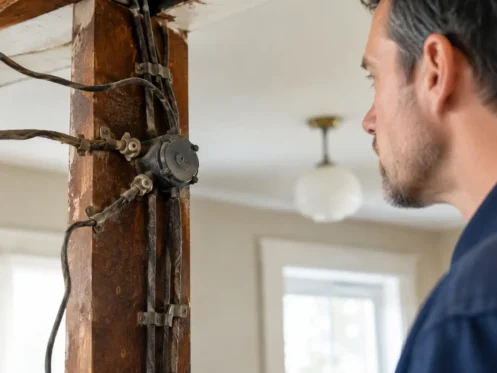
A beautiful older home can hide an electrical system that was never designed for central air conditioning, countertop appliances, home offices, EV chargers, or the number of devices a modern family uses every day. So, is knob tube wiring safe? The honest answer is: it depends on its condition, how it has been altered, and what has changed around it over the decades.
Knob-and-tube wiring is not automatically an emergency simply because it is old. But it does require a careful, professional evaluation. In many older homes around Mebane, Durham, Burlington, and Chapel Hill, the bigger concern is not the original installation alone. It is the aging insulation, overloaded circuits, hidden splices, renovations, and added attic insulation that may have come later.
What Knob-and-Tube Wiring Is
Knob-and-tube wiring was commonly installed in homes from the late 1800s through the 1940s. Instead of the bundled electrical cables used today, it uses separate hot and neutral conductors. Porcelain knobs hold wires away from framing, while porcelain tubes protect wires where they pass through wood.
When installed correctly and left undisturbed, this design allowed air to circulate around the conductors and help manage heat. That detail matters because knob-and-tube systems were not designed to be buried under modern insulation or modified with materials and methods that trap heat.
These systems also generally do not include a grounding conductor. That does not mean every outlet in an older home is unsafe on its own, but it does limit protection for many modern appliances and electronics. A three-prong outlet does not create a ground unless the wiring behind it has been properly upgraded.
Is Knob Tube Wiring Safe When It Is Still Working?
Lights that turn on and outlets that appear to work do not prove that old wiring is safe. Electrical problems often develop gradually, out of sight. The cloth or rubber insulation around knob-and-tube conductors can become dry, brittle, cracked, or missing after many decades. Once bare conductors are exposed, contact with wood, metal, insulation, or another wire can create a shock or fire hazard.
The system’s original capacity is another concern. Older homes were wired for a much lighter electrical load. A circuit that once served a few lights may now be asked to support televisions, space heaters, kitchen appliances, window AC units, and charging devices. Frequent tripped breakers, blown fuses, warm outlets, flickering lights, or a burning odor are warning signs that deserve prompt attention.
There is also a difference between intact knob-and-tube wiring and knob-and-tube wiring that has been altered over time. Homeowners, handymen, and previous contractors may have tied newer wiring into the original system, added outlets, changed light fixtures, or made inaccessible splices. Those changes can create hazards even when portions of the original wiring remain in reasonable condition.
Why Attic Insulation Can Change the Risk
One of the most common concerns with knob-and-tube wiring is attic insulation. Because the conductors were designed to release heat into open air, covering them with loose-fill, batt, or spray-foam insulation can cause the wiring to retain more heat than intended.
This does not mean a homeowner should remove attic insulation without professional guidance. Insulation plays an important role in comfort and energy efficiency. It does mean that an electrician should inspect the wiring before insulation is installed, added, or disturbed in an older home.
A careful inspection can determine whether knob-and-tube conductors are active, abandoned, damaged, or routed through areas that need attention. It can also help you plan a practical upgrade rather than discovering a problem after an insulation project, home sale, or renovation is already underway.
Signs You Should Schedule an Electrical Inspection
Some homes with knob-and-tube wiring appear quiet and trouble-free until a renovation exposes damaged conductors. Others provide clear warning signs. Schedule an inspection if you notice any of the following:
- Flickering or dimming lights, especially when an appliance starts
- Breakers that trip repeatedly or fuses that blow
- Two-prong outlets, loose outlets, or outlets that feel warm
- A burning smell, buzzing sound, discoloration, or sparks
- Wiring visible in the attic, basement, crawl space, or unfinished walls with cracked insulation
- Recent or planned insulation, remodeling, panel work, appliance upgrades, EV charging, or generator installation
If you smell burning, see smoke or sparking, or have a hot panel or outlet, treat it as an urgent issue. Turn off power to the affected area if it is safe to do so and call a qualified electrician. Do not keep resetting a breaker or replacing a fuse to make the problem go away.
When Replacement Is the Better Long-Term Choice
A full rewire is not always the first recommendation, but it is often the right permanent solution when active knob-and-tube wiring is widespread, deteriorated, overloaded, or altered improperly. Replacement may also make sense when you are opening walls for a major renovation. Doing the electrical work while access is available can prevent repeated drywall repairs later.
Modern wiring provides grounding, improved insulation, and a better foundation for current electrical needs. It also allows an electrician to bring affected areas up to current safety requirements, including properly protected outlets in kitchens, bathrooms, garages, laundry spaces, and exterior locations where applicable.
The scope can vary significantly. One property may need only a few unsafe circuits replaced and a panel evaluation. Another may need a phased rewiring plan, new dedicated circuits, a service upgrade, or a panel replacement to support a remodeled kitchen, heat pump, workshop, generator connection, or EV charger.
The right recommendation should be based on an inspection, not a guess. A professional should explain what is active, what is damaged, what needs immediate correction, and what can be planned over time. That kind of clear communication helps homeowners make decisions based on safety and budget without minimizing a real hazard.
What a Professional Inspection Should Look For
A thorough electrical inspection goes beyond looking at a few visible wires in the attic. The electrician should assess the service panel, circuit protection, accessible wiring, outlets, switches, junction boxes, grounding, signs of overheating, and previous modifications.
They may test circuits and identify whether knob-and-tube wiring is still energized. They should also look for mixed wiring methods, unprotected connections, over-fused circuits, and locations where insulation or construction materials contact old conductors.
For buyers, sellers, Realtors, and property managers, this information can be especially valuable before a transaction or tenant turnover. An inspection provides a clearer picture of the electrical system’s condition and helps prioritize repairs before they become a disruption or a safety concern.
Do Not Make Knob-and-Tube Wiring a DIY Project
Old wiring can be deceptive. A wire may look abandoned but still be energized, and circuits in older homes are not always labeled accurately. Replacing outlets with three-prong receptacles, covering wires, adding insulation, or connecting new cable to old conductors without the right evaluation can create a dangerous situation.
A licensed electrician can identify the safest repair path and complete work with proper materials, connections, and circuit protection. Mebane Electrical Services approaches older-home electrical work with the same goal as any repair: find the root cause, explain the options clearly, and complete work that is built to last.
If your home has knob-and-tube wiring, do not assume the worst, but do not assume age is harmless either. A straightforward inspection can replace uncertainty with a practical plan for protecting your home, your family, and the improvements you want to make next.