
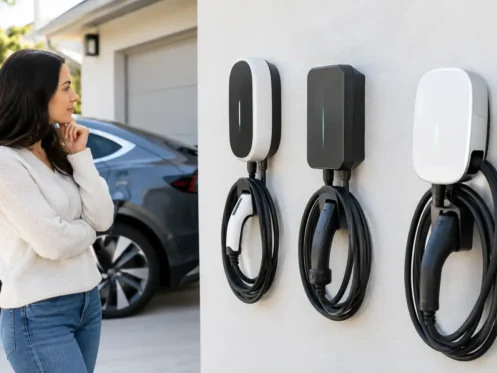
A useful EV charger comparison starts with more than the charger on the wall. The right choice depends on your vehicle, daily driving habits, electrical panel capacity, parking layout, and whether your home can safely support a new dedicated circuit. A charger that looks like a bargain can become expensive if it is undersized for your needs or requires electrical upgrades that were never considered.
For most homeowners, Level 2 charging is the practical answer. But the best Level 2 charger is not automatically the one with the highest advertised amperage or the longest list of app features. The goal is dependable overnight charging, installed correctly, with enough capacity left for the rest of your home.
EV Charger Comparison: Start With Charging Levels
Home EV charging usually falls into two categories: Level 1 and Level 2. DC fast charging is common at public charging stations, but it is generally not a home installation option because of its cost and electrical demand.
Level 1 charging
Level 1 charging uses a standard 120-volt outlet. Many electric vehicles include a portable charging cord that can plug into a properly grounded household receptacle. It is the slowest option, often adding only a few miles of driving range per hour.
For someone who drives short distances, has a plug-in hybrid, or can leave the vehicle parked for long periods, Level 1 may be enough. It can also be a useful backup option. However, it should not be treated as an automatic solution. Older outlets, loose connections, worn receptacles, and circuits shared with other equipment can create overheating risks during long charging sessions.
Level 2 charging
Level 2 equipment operates on a 240-volt circuit, similar to an electric dryer or range. It can add significantly more range per hour and is the preferred option for most fully electric vehicles. A Level 2 charger makes it much easier to come home, plug in, and start each day with the range you need.
Level 2 is not one single speed. Units are available at different output levels, often from 16 amps to 48 amps or more. Higher output can shorten charging time, but only if the vehicle can accept it and the electrical system can support the required circuit.
Match Charger Output to Your Vehicle and Driving Routine
A 48-amp charger sounds better than a 32-amp model until you look at the real-world need. If your vehicle is parked overnight for 10 to 12 hours, a 32-amp or 40-amp charger may easily restore the energy used during a typical commute. Paying for maximum output may not provide much added value.
Your vehicle’s onboard charger also sets a limit. The wall-mounted equipment supplies available power, but the vehicle determines how much AC power it can accept. If your EV accepts only 32 amps, installing a 48-amp unit will not make it charge faster.
Daily mileage matters as well. A household with one EV driven 30 miles per day has very different needs than a family with two EVs, longer commutes, or frequent trips to Durham, Chapel Hill, or Burlington. An electrician can help you choose a charging rate that fits your routine without placing unnecessary strain on your electrical system.
Plug-In vs. Hardwired EV Chargers
Level 2 chargers are usually available as plug-in or hardwired units. Both can be good choices when installed properly.
A plug-in charger connects to a dedicated 240-volt receptacle, often a NEMA 14-50 outlet. This arrangement can make it easier to replace the charger later or take it with you when moving. The outlet, wiring, and breaker still need to be rated for continuous EV charging. A receptacle that is suitable for occasional appliance use may not perform well under years of daily charging.
A hardwired charger is connected directly to the electrical circuit. It eliminates the receptacle and plug connection, which can reduce one potential point of heat buildup or failure. Hardwired installations can also support higher charging outputs in some situations. For homeowners who plan to stay in the property and want a clean, permanent setup, hardwiring is often the better long-term choice.
The correct answer depends on the charger rating, circuit design, location, and future plans for the home. It is not simply a matter of convenience.
Smart Features: Helpful, but Not Always Necessary
Smart chargers connect to Wi-Fi or an app. Depending on the model, they may track energy use, schedule charging during lower-rate utility hours, send charging alerts, and manage power between multiple chargers. These features can be valuable, especially for homeowners on time-of-use electric rates or properties with more than one EV.
A basic charger may be the better fit if you want reliable charging without another app, account, or wireless connection to manage. A simpler unit can still provide safe, efficient charging when it is listed for its intended use and installed on the right circuit.
If you are comparing smart chargers, ask practical questions. Will the charger continue to work if Wi-Fi goes down? Is scheduling controlled by the vehicle already? Does the app require a subscription? Can the unit share available electrical capacity if a second EV is added later? Features should solve a real problem, not create another device to troubleshoot.
Your Electrical Panel Is Part of the Decision
The charger itself is only one part of the project. EV charging is considered a continuous electrical load, meaning the circuit must be sized with safety margin. For example, a charger drawing 40 amps generally requires a 50-amp circuit. The wire size, breaker type, disconnect requirements, and installation method must all meet applicable electrical code.
Just as important, the home’s electrical service must have adequate capacity. A newer 200-amp panel may have room for an EV charger, but that is not guaranteed. A home with electric heat, electric water heating, a range, dryer, hot tub, workshop equipment, or a second HVAC system may need a formal load calculation before adding a charger.
Older homes throughout the Mebane area may have smaller panels, outdated equipment, or limited space for new breakers. In those cases, the best charger decision may include a panel upgrade, a subpanel, load-management equipment, or a lower-output charger. That is not a setback. It is how the installation is designed to work safely for the long term.
Location, Cable Length, and Outdoor Use Matter
Before purchasing a charger, think through where the vehicle actually parks. A charger placed too far from the charging port can leave the cable stretched across a walkway, driveway, or garage floor. A longer cable is convenient, but it should still be stored properly and kept away from damage.
For outdoor installations, choose equipment rated for the environment and use a mounting location that protects it from unnecessary impact and water exposure. The electrical wiring needs proper protection as well. Garage installations may need safeguards against vehicle contact, while detached garages or exterior parking areas can require trenching, conduit, and additional planning.
It is also worth considering the next vehicle, not just the current one. Connector standards and manufacturer preferences have been changing. Many chargers use the J1772 connector, while more vehicles are moving toward the North American Charging Standard. Adapters can address many situations, but a qualified electrician can help you plan a setup that remains practical as your household changes.
Do Not Choose Based on Price Alone
The lowest-priced charger may lack the weather rating, cable quality, warranty support, or safety certification needed for daily use. On the other hand, the most expensive unit may include features you will never use. Look for equipment listed by a recognized testing laboratory and select a charging output that matches the vehicle and available electrical capacity.
Installation costs also vary for good reasons. A charger mounted near the panel in an attached garage is typically more straightforward than one installed at a detached garage, across a finished basement, or at the end of a long driveway. Transparent estimates should explain the scope of work, including the circuit, breaker, wiring route, charger mounting, permits when required, and any panel-related work.
A professional installation is not just about making the charger turn on. It is about protecting the wiring, avoiding overloaded equipment, securing the connections, and leaving you with a charging setup you can rely on every day.
For homeowners who want clear answers before buying equipment, Mebane Electrical Services can evaluate the charging location and electrical capacity, explain the practical options, and install a charger designed for safe, dependable use. The right home charger should make owning an EV easier – not add uncertainty to your electrical system.